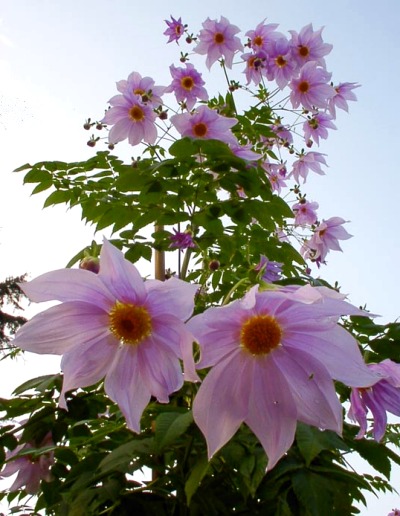
Pot size -- I recommend growing your Tree Dahlia in a 2-4 quart pot the first 2 months, so you can slowly move it from shade to sun during that time. Soil -- Tree Dahlia likes fertile soil
that is well-draining. An example would be a mix of 2 parts quality
potting soil After repotting -- The first week, give it bright shade or filtered sun, and no liquid fertilizer. After a week, give it some morning sun or the equivalent lighting, and increase the sun a little each week, watching for wilting or burning. Your plant hasn't formed a tuber yet, so to keep it from trying to go dormant, keep it above 50 degrees the first winter, preferably with at least 11 hours of light per day. The second winter, it can take cooler temps, but try to keep it from freezing. Watering -- The first few months, keep the soil evenly moist (but not constantly soggy). As the plant's root system gets larger, you can let the soil dry out halfway, but avoid letting it get completely dry. If the leaves should wilt, water it. Fertilizing
-- Feed about every 2 months during the growing season with a Climate -- Established plants like full sun to a half-day of sun. In hotter climates, some afternoon shade might be appreciated, as well as growing in an oversized pot, to keep the roots cooler. The young shoots and flower sprays are fairly brittle, so protect them from strong winds, or stake them in windy areas. Repotting -- After 2 months, you may transfer it to a larger pot, like a 3 gallon pot. Once it has rooted through that, you can move it to a bigger pot, or plant it in the ground in suitable climates. Pruning -- If you don't want a monster-sized plant, or you want to encourage side branches & bushiness, simply prune the top. Flowering -- The plant flowers late in the year, in November or December, so frost may destroy the flowers, depending on where you live. Growing it under a tree might provide a few degrees of frost protection. Dormancy -- Around January, after flowering is done, the plants usually drop some or all of their branches. You may cut the remaining branches to the ground after flowering if you wish, or leave them. Tubers of mature plants are said to be hardy to 20-25 degrees F (-7 to -4°C) if planted deep and well-mulched. Or just dig the tubers up and move them indoors until about April or May. Keep the tubers slightly moist to prevent shriveling, perhaps by placing them in moist sphagnum moss. Bugs to watch for -- Spider mites, Aphids, leaf-miners, snails/slugs. Powdery mildew might affect the leaves. Feel free to contact me if you have questions. Enjoy your plant! - Jeff Strange Wonderful Things
|
|||||||||
 to 1 part perlite or coarse horticultural sand. It is fairly tolerant of a
variety of soils, but avoid extremes like hard clay or excessive sand.
to 1 part perlite or coarse horticultural sand. It is fairly tolerant of a
variety of soils, but avoid extremes like hard clay or excessive sand. n
all-purpose fertilizer that contains micronutrients. Stop feeding in
September, since it will be going dormant soon.
n
all-purpose fertilizer that contains micronutrients. Stop feeding in
September, since it will be going dormant soon.