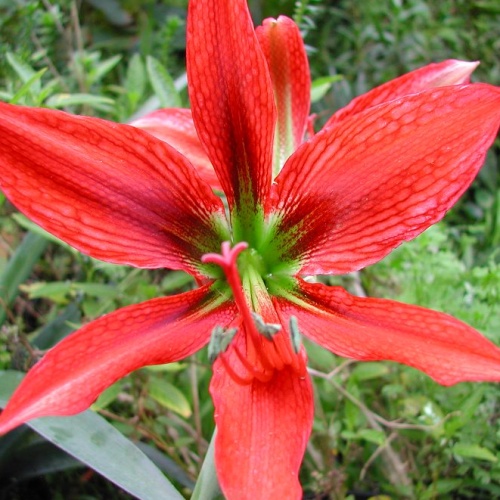
Hippeastrum aulicum var. robustum
Germinating the seeds
The seeds are fragile, so please handle them gently
When to plant -- Start your seeds immediately for the best germination - don't store them. Getting started -- If you have germinated other Hippeastrum seeds before, you may use the same method that works for you. These seeds sprout well by soaking them in water - see: Sprouting seeds in water. To begin, put them in a small cup of water, and place it in a spot that will stay between 70 and 78 degrees F (20-26°C) during the day. A bit cooler at night is ok. Avoid letting them get too hot or cold. I recommend placing a minimum/maximum thermometer near the cup. Keep it in a bright spot out of direct sun. A bright LED panel or bulb kept 3 inches (8 cm) away provides the right amount of light (See: "Growing indoors with LED lights"). Replace the water every day or two. They should start sprouting within about 10 to 20 days, but occasionally longer. A root will appear first, followed by a
leaf. Once the root is about an inch (2.5 cm) long, gently repot the seed
into a well-draining soil mix. A typical mix is 2 parts potting soil to 1 part
perlite Drip some water over the seeds daily or as needed to keep the root moist. Continue providing bright, filtered light. Fertilizing -- Once a leaf appears, give a small amount of dilute (1/8 strength) liquid fertilizer,
and repeat 2 and 4 weeks later.
Hydroponic fertilizer
is ideal for small seedlings, because it is easily absorbed and contains all essential
nutrients. After 2 months, you may switch to a granular fertilizer Growing onward... Climate -- It comes from a mild climate in Brazil, with temperatures similar to San Diego. Indoor temperatures suit it well. It can tolerate heat, but it prefers cool nights if days are hot. It can take cool days, but protection from frost is essential. Light -- Bright, filtered light seems to be the best. It can handle weaker sun, but protection from strong afternoon sun is needed. Fertilizing -- It has average fertilizer needs. When it's not dormant, feed about every 3 months with a general-purpose fertilizer that contains micronutrients. Follow the dosage on the package. Repotting -- Transplant to a larger pot whenever needed. A mature bulb can flower in a 5-6 inch (12-15cm) pot, or even a bit smaller if it has no offsets. Repotting when the bulb is near flowering size might delay flowering. If you must repot a flowering-size bulb, avoid disturbing the roots. Dormancy -- The bulb may drop some or all of its leaves and go through a brief dormancy period, typically around summer, especially if nights are cool. Don't let the roots dry out during this time. Flowering -- When the bulb nears flowering size (2 inches / 6 cm wide), try to expose it to cool nights for 6 weeks in summer or autumn, to encourage flowering. Temperatures should be between about 40-62° F (4-17°C) for several hours at night (don't allow it to freeze). The bulb might defoliate from this, but it will emerge from dormancy when returned to warmer temperatures. Flowering typically occurs right after this (if the bulb is ready to flower). Pests to watch for -- Look for any bugs that can affect your other houseplants. Try spraying with insecticidal soap first before using harsher chemicals. Try to keep the plants above 45 degrees F (7°C) the first year. Have fun growing them! - Jeff Strange Wonderful Things
|
|||||||||

 (use small- or medium-size perlite, not large chunks). Use small
containers or cups with drainage holes. Plant the seed with root tip down,
and completely cover the root with soil, but don't bury the seed too deeply.
(use small- or medium-size perlite, not large chunks). Use small
containers or cups with drainage holes. Plant the seed with root tip down,
and completely cover the root with soil, but don't bury the seed too deeply. that contains micronutrients, following the dosage on the package.