| Home |
Strange Wonderful Things
Rare and exotic plants
|
 |
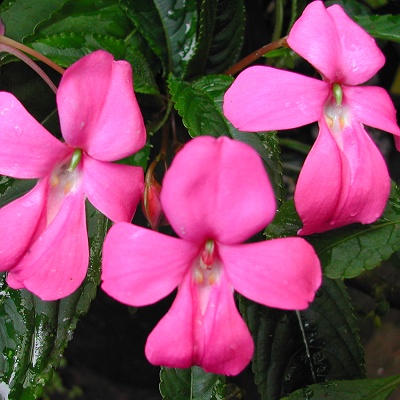
Impatiens latiflora
Germinating the seeds
When to plant -- Plant your seeds when you receive them for best results.
Getting started -- You may plant each seed in individual, small containers,
such as seedling starter trays . Or you plant them all in a single,
larger
container, but it may be difficult to separate the roots later. Either way, use
containers with drainage holes . Or you plant them all in a single,
larger
container, but it may be difficult to separate the roots later. Either way, use
containers with drainage holes
Use well-draining soil. I use a mix of 1 part
coir fiber to 1 part perlite
 (use small- or medium-grade perlite, not coarse-grade). An alternate mix is 2 parts
quality potting soil
(use small- or medium-grade perlite, not coarse-grade). An alternate mix is 2 parts
quality potting soil to 1 part perlite. to 1 part perlite.
Fill the pots with soil and
place a seed or 2 on the surface.
If you have
long-fibered sphagnum moss , sprinkle
a small amount over the
surface. This helps retain
moisture around the seeds while allowing light to reach them, which aids
germination. The amount of moss to use is shown in
this photo.
If you don't have the moss, sprinkle a small amount of your soil mix around the
seeds. Then add water until everything is evenly moist (but not soggy). , sprinkle
a small amount over the
surface. This helps retain
moisture around the seeds while allowing light to reach them, which aids
germination. The amount of moss to use is shown in
this photo.
If you don't have the moss, sprinkle a small amount of your soil mix around the
seeds. Then add water until everything is evenly moist (but not soggy).
Until the seeds sprout, ensure that the surface soil always stays moist. A plastic dome or bag may be used to
maintain near-100% humidity, but leave it open a crack to allow some fresh air in. You may need to drip a few drops of water over the seeds every day to keep the seeds
moist.
The ideal temperature for germination is between 65 to 77 degrees F (18-25°C). A little cooler at night is ok.
Avoid letting them get above 80° F (27°C) for prolonged periods. I recommend placing a minimum/maximum thermometer near the pots. near the pots.
A fluorescent or LED bulb kept 4 inches (10 cm) away provides the right amount of
light. Protect from direct sun.
They should start germinating in 3 to 5 weeks, and continue for about a month. For the first 2-3 weeks after sprouting, continue keeping the
soil surface moist. After that, you may remove them from any plastic dome.
Fertilizing -- The first
6-8 weeks, feed every 7 days with a small amount of dilute (1/8 strength) liquid fertilizer. Hydroponic fertilizer is ideal for this, because it is easily absorbed and contains all essential nutrients. I use General Hydroponics Flora fertilizer , using 1 teaspoon/gallon (5 mL
per 4 liters). After 6-8 weeks, you may switch to granular fertilizer
that contains micronutrients (I use
this). Or continue feeding weekly with liquid fertilizer at 1/8 strength. , using 1 teaspoon/gallon (5 mL
per 4 liters). After 6-8 weeks, you may switch to granular fertilizer
that contains micronutrients (I use
this). Or continue feeding weekly with liquid fertilizer at 1/8 strength.
If the older leaves appear pale or yellowish, the soil may be too dry down in the root zone. If soil moisture levels have been fine,
the plant may need more nitrogen fertilizer.. especially if light levels are high.
Growing onward...
Lighting -- This Impatiens prefers bright shade, or filtered sunlight. Avoid prolonged direct sun, unless it's early-morning sun.
Transplanting -- When your plants are 2-3 months old, you may gently transfer them to a larger pot. Water the soil first, and avoid letting the soil ball break
apart, which can damage the roots. After transplanting, avoid packing the soil down, and do not fertilize the first week.
Watering -- Aim to keep the soil moist most of the time. Don't let
it dry out completely, but don't keep it constantly soggy either. If
you're unsure if the soil down in the root zone has the proper moisture, you can
use a moisture meter . .
Climate -- This Impatiens prefers mild temperatures. In warmer
conditions, give it plenty of shade and moisture. Protect from freezing temperatures.
Over about
40% humidity is best. If your plants seem to suffer from low
humidity indoors, consider using an
ultrasonic humidifier.
Pests to watch for -- aphids, scale
(dark disks on the stems), mealy bugs. Try using
insecticidal soap
before using stronger remedies, since some may harm the plant.
Have fun growing them!
- Jeff
Strange Wonderful Things
| Home |
Strange Wonderful Things
Rare and exotic plants |

|
| Entire site Copyright 2003-2023 by Strange Wonderful Things, except as noted |
|
 . Or you plant them all in a single,
larger
container, but it may be difficult to separate the roots later. Either way, use
containers with drainage holes
. Or you plant them all in a single,
larger
container, but it may be difficult to separate the roots later. Either way, use
containers with drainage holes to 1 part
  (use small- or medium-grade perlite, not coarse-grade). An alternate mix is 2 parts
quality
(use small- or medium-grade perlite, not coarse-grade). An alternate mix is 2 parts
quality  to 1 part perlite.
 , sprinkle
a small amount over the
surface. This helps retain
moisture around the seeds while allowing light to reach them, which aids
germination. The amount of moss to use is shown in
, sprinkle
a small amount over the
surface. This helps retain
moisture around the seeds while allowing light to reach them, which aids
germination. The amount of moss to use is shown in
 near the pots.
 , using 1 teaspoon/gallon (5 mL
per 4 liters). After 6-8 weeks, you may switch to granular fertilizer
that contains micronutrients (I use
, using 1 teaspoon/gallon (5 mL
per 4 liters). After 6-8 weeks, you may switch to granular fertilizer
that contains micronutrients (I use
 .
.