| Home |
Strange Wonderful Things Rare and exotic plants |
 |
|---|
Marmalade Bush
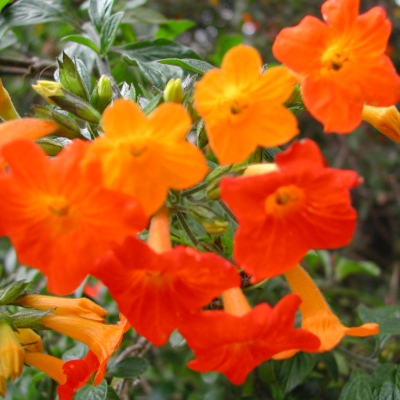
Streptosolen jamesonii
Getting started -- The young stems can be fragile, so please be careful removing your plant from it's packaging. Feel free to support the branches upright upright the first month or two until they become firmer.
Start your plant in pot about 1 quart in size or a bit smaller. It does best in well-draining soil. A typical mix is 2 parts potting soil to 1 part perlite.
Your plant was grown in filtered light, not direct sun, so it should be acclimated to direct sun slowly. Start it in bright shade and give it a bit more sun each week over a period of several weeks, with some protection from strong afternoon sun the first 3-4 months. Watch for wilting or burning after increasing the sun.
Watering -- It prefers soil that's evenly moist. Don't allow the soil to dry out completely, but don't keep it constantly saturated either.
Climate - The Marmalade Bush can probably take only a light, brief frost, so it needs protection from all frost. I don't know how much heat it can handle. If it shows signs of heat stress, give it some shade during the hottest part of the day.
It likes a half day of sun to full sun, although it can still flower in less than half sun as long it's bright. You may grow your plant indoors in a bright spot.
Fertilizing -- During periods of active growth, feed with a general-purpose fertilizer, following the dosage on the package.
Pruning -- While pruning isn't required, you can prune it to shape it. To encourage an upright, tree-like shape, remove some side branches on the lower part of the plant. If you want the plant to stay low and spill over a wall or hanging planter, trim back the taller branches. Avoid removing too many branches at a time.
If you wish, you can tie the plant along a trellis or fence, or over an arbor.
Bugs to watch for -- Spider mites (tiny "dots" under the leaves), Aphids (green ones are hard to see), white mealy bugs, and scale (brown discs on the stem - hard to see).
If you have any questions or problems, please contact me.
Enjoy your plant!
- Jeff
Strange Wonderful Things
| Home |
Strange Wonderful Things Rare and exotic plants |
|
|---|---|---|
| Entire site Copyright 2003-2025 by Strange Wonderful Things, except as noted | ||