Germinating the seeds
» Your seeds should be planted the day you receive them » They might sprout during shipping, so be careful when opening the packet, to avoid damaging the root.
If you have germinated other Clivia seeds before, you may use the same technique that worked for you. The method below works well for me and reduces the chance of rot. You may plant them all in a single, small
container, since they will be removed after they sprout. Use pots about 3 inches (8 cm) tall
with drainage holes. Fill with
perlite Look for the dark spot on the seed. Plant that side up, since the root will emerge from the other end, which may have a small nub. Push the seeds into the surface so that about 1/3 of the seed is visible. Space the seeds about 1 inch (3 cm) from each other. Water the perlite thoroughly. The optimal germination temperature is about 66-77° F (19-25°C) during the day. A little cooler at night is ok. Avoid
letting them get above 80° F (27°C). I recommend placing a
minimum/maximum thermometer Ensure that the perlite always stays moist. If you enclose the pot in a plastic container or bag to maintain moisture, leave it open slightly for fresh air to enter. You may need to drip some water over the perlite each day to keep it moist. Keep them in bright light out of direct sun. A bright LED bulb or panel placed 4 inches (10 cm) away provides the right amount of light (See: "Growing indoors with LED lights"). The seeds will first grow a root, followed by a leaf about 2-4 weeks later. They tend to sprout at different times, with most of them sprouting between 1 and 2 months. Occasionally they can take up to 6 months, so as long as the seeds are firm and white, don't give up on them! After they sprout, continue giving bright light, with no direct sun for the first 3 months. Try to avoid keeping the leaf wet. Sometimes the seeds will lift themselves up when sprouting and the root will be exposed. If this happens, reposition it so the root is buried, being gentle not to damage the root. When the first leaf is 2 weeks old, gently dig up the seed and repot it into the soil mix described in the next paragraph. Use a container at least 5 inches (13 cm) tall, with drainage holes. I prefer to use 1 pot per seedling, but you may use a communal pot - just place the seedlings 3 inches apart (7 cm). Soil -- Use a well-draining
medium. A typical mix is 1 part
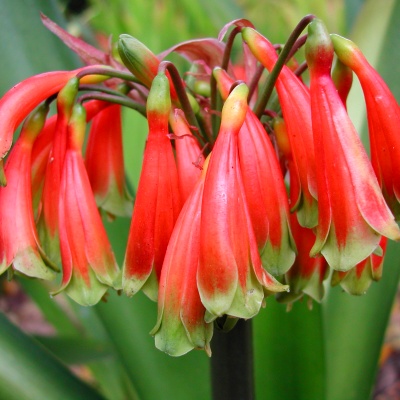
quality potting soil Watering - The plants like to have their roots kept moist, so aim to keep the soil evenly moistened, but not constantly saturated. Don't let it dry out completely, and don't let the pots sit in a tray of water. If your tap water is very "hard", meaning high in minerals, you might need to use bottled water or rain water if your plants seem stressed. Fertilizing -- A week after planting them in the new mix, i recommend feeding with a small amount of dilute (1/8 strength) liquid fertilizer. Hydroponic fertilizer is ideal for young seedlings, since it is easily absorbed and contains all essential nutrients. Repeat the feeding 2 and 4 weeks later. After that, the roots will reach the granular fertilizer in the soil mix. Growing onward.. Climate -- Clivia caulescens has similar requirements to the common Clivia. Ideal temperatures are below 85 degrees F (29°C), with nights that are cool. It's best to protect them from all frost, especially the first 2 years. Older plants can survive a few degrees of frost, but the leaves will be damaged. Bright shade or filtered sun is best. Avoid strong sun exposure. Over about 40% humidity is best. Re-potting -- Once the plants have
4 leaves, they may be moved to a 2 quart (2 liter) pot. Use a "chunkier"
mix than before. A typical mix is 1 part small orchid bark or coco chips,
1 part potting soil Six months later they can go in a 1-2 gallon (4-8 liter) pot, and after 2 years, move them to a 5 gallon (20 liter) pot, where they can stay until they flower. They flower best when root-bound, so avoid using an oversized pot. Avoid repotting when it nears flowering size, since it may delay flowering. Flowering -- It's likely that this species needs cool nights in winter to trigger flower, like the common Clivia. So once the plants are 3 years old, try to expose them to temperatures between 40 and 60° F (4-15°C) for about half the day for 4 to 8 weeks in autumn. Reduce watering slightly in cooler temperatures, but don't let the soil dry out. If you have questions, feel free to contact me. - Jeff Strange Wonderful Things
|
|||||||||
 .
Use small- or medium-size perlite, not large chunks.
.
Use small- or medium-size perlite, not large chunks. near the pots.
 to 1 part
perlite or coarse
horticultural sand. Don't add lime to the mix. After filling the pots, don't compress the soil.
Continue keeping them in moderate temperatures the first 6 months.
to 1 part
perlite or coarse
horticultural sand. Don't add lime to the mix. After filling the pots, don't compress the soil.
Continue keeping them in moderate temperatures the first 6 months.