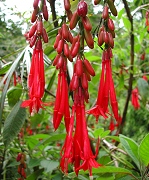
Bolivian Fuchsia
Germinating the seeds
When to plant -- Plant your seeds right away for best results. Getting started -- You may plant each seed in individual, small containers,
such as
seedling starter trays Use well-draining soil. I use a mix of 1 part
coir fiber Fill each container almost to the top. Don't compress the soil. Place 2 or 3 seeds on top, and sprinkle a very thin layer of soil on top - just enough to barely cover the seeds (1/8", or 2 mm). Add water until the soil is evenly moist (but not soggy). Moderate temperatures are best for germination - about 65-77 degrees F / 18-25 degrees C.
A little cooler at night is ok. Avoid letting
them get above 80° F (27°). I recommend placing a minimum/maximum thermometer Ensure that the soil surface never dries out. If you place the pots in a humidity dome or bag to maintain moisture, leave it open slightly to let some fresh air in. You may need to drip a few drops of water on them each day. Keep them in a bright spot, but not in direct sun. A fluorescent or LED bulb kept 4 inches (10 cm) away provides the right amount of light. Most of the seeds should sprout within 4 weeks, but allow up to 8 weeks for any slow ones to sprout. Once they sprout, increase the air ventilation a bit to avoid getting stem rot. Until the seedlings are 4 weeks old, keep the soil surface moist. I recommend growing them indoors until they're at least 3 months old. For lighting, you may use a fluorescent or LED bulb kept about 4-6 inches (10-15 cm) from the plants. Do not use incandescent (screw-in) bulbs, even if they're called "plant bulbs". You can also put them in filtered sunlight. Protect them from strong, direct sun. Fertilizing -- Feed weekly
with a very dilute (1/8 strength) liquid fertilizer.
Hydroponic fertilizer
is ideal for this, because it is easily absorbed and contains all essential
nutrients. I use
General Hydroponics Flora fertilizer If you have more than one seedling in each container, snip off the weaker one(s) when they are 4-6 weeks old - or very carefully dig them them. Over about 40% humidity is best. If your plants seem to suffer from low humidity indoors, consider using an ultrasonic humidifier. Growing onward.. Repotting - Repot your plants to larger containers whenever the plant becomes root-bound. Water the soil before repotting, to keep the soil ball from breaking apart, which can damage the roots. Watering - Aim to keep the soil evenly moist most of the time. Do not let the soil dry out. If you're unsure if the soil is moist enough down in the root zone, you can use a moisture meter. Fuchsia boliviana prefers filtered sunlight, with protection from strong afternoon sun. Morning sun + afternoon shade is fine, as is tree-filtered sunlight all day. Protect from strong afternoon sun. The plant prefers moderate temperatures and cool nights. The ideal temperature would be between 45 and 80° during the day (7-27°C), and 40-66° at night (4-19°C). In warmer climates, give the plants afternoon shade, and keep the pot shaded to avoid overheating the roots, or at least avoid black pots. Protect the plants from all frost. Over about 40% humidity is best. If your plants seem to suffer from low humidity indoors, consider using an ultrasonic room humidifier Pests to watch for - whitefly, aphids, scale (little lumps on the stems or leaves), mealybugs, thrips. Try using insecticidal soap before using stronger remedies, since some may harm the plant. If you have any questions, feel free to contact me. Have fun growing them! - Jeff Strange Wonderful Things
|
|||||||||

 . Or you plant them all in a single,
larger
container, but it may be difficult to separate the roots later. Either way, use
containers with drainage holes
. Or you plant them all in a single,
larger
container, but it may be difficult to separate the roots later. Either way, use
containers with drainage holes to 1 part
  (use small- or medium-grade perlite, not coarse-grade). An alternate mix is 2 parts
quality
(use small- or medium-grade perlite, not coarse-grade). An alternate mix is 2 parts
quality  to 1 part perlite.
 near the pots.
  ,
using 1 teaspoon per gallon (5 mL per 4 liters). After 6-8 weeks, you may
switch to granular fertilizer
that contains micronutrients (I use
,
using 1 teaspoon per gallon (5 mL per 4 liters). After 6-8 weeks, you may
switch to granular fertilizer
that contains micronutrients (I use