Germinating the seeds
Plant your seeds immediately for the best germination rate Seed pre-treatment -- Soak your seeds in room-temperature water for about 6 to 12 hours (not more than 24 hours). Use
a separate pot for each seed. The pots should be about 2-3 inches tall (5-10
cm), with drainage holes. For soil, use a well draining mix. I use a mix of 1 part
coir fiber Place a seed on top and cover with about 1/4 inch (6 mm) of soil. Water the soil until evenly moist. Keep the pots in an area that will stay about 55-78 degrees F (13-26°C) during the day, and 45-65 (7-18°C) at night. Avoid letting them get above 80 degrees F (27 C) for prolonged periods. I recommend placing a minimum/maximum thermometer near the pots. Keep the soil surface moist (but not soggy). You can maintain moisture by placing the pots in a plastic dome or bag that is kept slightly open to allow some fresh air to enter. The seeds tend to sprout at different times, usually between about 6 weeks and 3 months. If any don't sprout after 3 months, move the pots to an area that is between 35 and 55 degrees F (2-12°C) at night for 6 weeks, to trick them into thinking winter has passed. If you can't provide these conditions, put them in the refrigerator (placed in a sealed plastic bag or container first). Mark your calendar to check up on them every 2 weeks, in case any sprout in the refrigerator. After the 6 weeks, move them back into the temperature range mentioned previously. They should start sprouting after 8 weeks. Once they sprout give them bright light, with protection from strong, direct sun. A bright LED or fluorescent bulb kept 3-4 inches (8-10 cm) away provides the right amount of light (See: "Growing indoors with LED lights"). The first few months, try to keep them in moderate temperatures and avoid hot conditions. Transplanting -- Repot gently when the second shoot appears. Work your way up to larger pots as it grows, until they're eventually in a 5-10 gallon (20-40 liter) pot by the third year. Avoid breaking apart the soil ball when repotting; watering the soil first can help. Always shade the plant from prolonged sun for a week after transplanting. Light -- Bomarea comes from the forests, where it gets tree-filtered sun most of the time. Aim for about 50% sun. Protect it from strong afternoon sun, except in cool, coastal areas. Watering -- Bomarea likes soil that's kept evenly moist (but not constantly soggy). Climate -- Most Bomareas prefer mild temperatures and cooler nights. I don't have experience with this one in hot conditions, but it might not thrive if temperatures consistently get above 85 degrees F (30 C), especially if nights are warm. The foliage may be killed by frost, but the tubers should be hardy to at least 25 degrees F (-4 C). Still, i recommend protecting the plant from freezing temperatures. It warmer climates, avoid keeping the pot exposted to sun. Fertilizing -- Feed weekly with a very
dilute (1/8 strength) liquid fertilizer.
Hydroponic fertilizer
is ideal for this, because it is easily absorbed and contains all essential
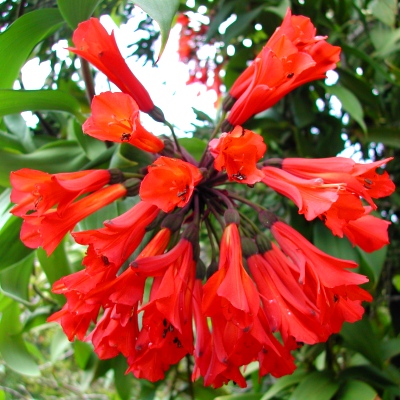
nutrients. After 6-8 weeks, you may switch to a granular fertilizer Up and away -- Bomarea likes to climb, so give it something to twine itself around, like a trellis, fence, or another plant. It should ideally be under 1 inch thick (3 cm), so the shoots can wrap around it. A 6 foot (2 meter) trellis should work, although larger is better if possible. If the shoots grow too long, wrap them down and around your trellis. Don't prune the shoots, since the flowers appear from the growing tips. By the way, the tubers are food storage organs and should not be dug up or separated, as this may damage the plant. Pests to watch for -- Snails and slugs can be a problem in prone areas. Watch for bugs that are common in your area. Feel free to contact me if you have questions. Have fun growing them! - Jeff Strange Wonderful Things
|
|||||||||
 to 1 part
 (use fine- or medium-size perlite, not large chunks). An alternate mix is 2 parts
quality potting soil
(use fine- or medium-size perlite, not large chunks). An alternate mix is 2 parts
quality potting soil to 1 part perlite. Don't add lime, since Bomarea likes slightly acid soil.
  that contains micronutrients,
following the dosage on the package. Or continue feeding weekly with
liquid fertilizer at 1/8 strength.
that contains micronutrients,
following the dosage on the package. Or continue feeding weekly with
liquid fertilizer at 1/8 strength.