Home

Strange Wonderful Things

Rare and exotic plants & seeds

Turquoise Puya


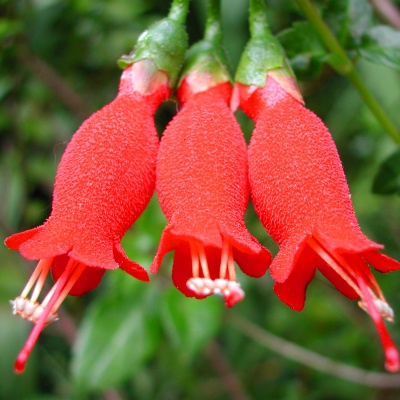
Red Mitraria 

Mitraria coccinea

Mitraria coccinea


Please take your time removing your plant from it's packaging.

Note -- Your plant was grown in filtered light, not direct sun, so it should be acclimated to sunlight very slowly. I recommend starting your plant in a 1 gallon pot, so you can slowly move it from shade to part sun over a period of several weeks.  Mitraria can burn from too much sun.   

Soil -- Mitraria likes rich soil that drains easily.  The soil should be slightly acid and have little to no lime.  A good mix would be approximately 2 parts well-decomposed compost to 1 part peat moss to 1 part sand or perlite, mixed well.  I like to add a slow-release organic fertilizer at planting time.    

Transplanting -- Mitraria doesn't like to be transplanted, so avoid disturbing the root mass.  Before removing your plant from its pot, give it a watering, so the soil doesn't break apart, which can damage the roots.  If you have trouble removing the plant, push the eraser end of a pencil into the holes at the bottom, and squeeze the sides of the container near the bottom while you gently slide the plant out.  Expect a little wilting of the stems after transplanting, which should perk up within a week. 

Watering -- First, a word about the type of water.  Many water companies add chlorine to tap water, which Mitraria doesn't care for.  Plus the pH of tap water is often too high.  The ideal would be rain water or bottled spring/distilled water.  You may also use tap water that's been run through a water filter, provided that your filter doesn't add sodium.  Avoid brands like Pur and Brita, which add sodium (if the package says "ion exchange filter" it adds sodium).  

For the first month, ensure that the original soil ball remains moist (but not soggy).  Don't allow the soil to dry out.  I recommend using a moisture meter, which you can get at most garden shops for about $5.  You stick the probe down to where the roots are and take a reading.  The needle should be between about halfway and wet.  Mitraria likes moist soil, but it shouldn't be constantly soggy either.  Never let the pot sit in a tray of water.  Also avoid keeping the leaves wet for prolonged periods, as this seems to cause leaf fungus. 

Acclimating to sun -- Start by giving your plant bright, indirect light or well-filtered sun for the first week.  After this, give it about an hour of morning sun per day.  If all looks well after a week, give it about an hour more sun every few weeks.  This will give your plant time to grow a larger root system, so it can handle more light without burning or wilting.  Mitraria prefers to have its sun filtered through trees (dappled sun), not prolonged direct sun.  Bright shade is fine provided that it does get some sun during the day. 

Planting out -- After your plant has doubled in size, it's ready to be planted in the ground.  If you're going to grow it in a container, repot to a 3-5 gallon pot when the roots reach the bottom of the 1 gallon container.  Repot again to a larger pot when it becomes rootbound.  Two things to keep in mind if you grow it in a pot - pots dry out quicker, and also keep the pot shaded, since Mitraria likes its roots cool.   

Climate -- Mitraria likes cool temperatures.  It's happiest between 45 and 75 degrees.  In warmer areas, it's best to give it mid-day shade, don't plant it where heat can collect, and mulch the plant to keep the roots cool and moist.  Established plants reportedly can take down to 16-20 degrees, however i would experiment with some cuttings, not the original plant.  You can grow Mitraria indoors or in a greenhouse provided that it gets good air ventilation and circulation.      

Fertilizing -- During periods of active growth, give feedings with ordinary vegetable fertilizer or the equivalent about every 6-8 weeks.  Follow the label's recommended dosage carefully.  Don't try to force more growth with more fertilizer.  It's normal for a few of the older leaves to yellow and die throughout the year, but if it's excessive, it could be from over- or under-watering, or from not enough fertilizer (nitrogen).    

Pruning & training-- Feel free to remove some stems to shape the plant.  You can tie the branches to a trellis or fence to train them in an upward habit, or you can let them trail along the ground or over a wall.  

Propagation -- Bury a length of stem in a pot of moist soil and it should eventually root.  Once the roots have reached several inches down, you can separate the stem from the mail plant, being careful to transplant gently.  Start the plant under low light, like a fluorescent bulb.  You can also start Mitraria from seed. 

Pests to watch for -- Spider mites (tiny "dots" on the leaves), ants.  Snails/slugs. 

If you have any questions or problems, please email me.

Enjoy your plant!

Jeff

Strange Wonderful Things


Home

Strange Wonderful Things

Rare and exotic plants & seeds

Turquoise Puya

Entire site Copyright 2004-2010 by Strange Wonderful Things, except as noted