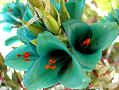
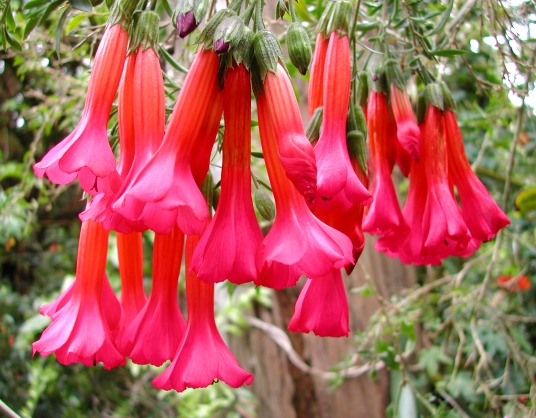
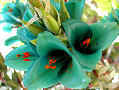
Cantua 'Hot Pants'
Please take your time removing your plant from it's packaging. Note -- Your plant was grown in filtered light, not direct sun, so it should be acclimated to sunlight slowly. I recommend starting your plant in a 1 gallon pot, so you can slowly move it from filtered sun to direct sun over a period of several weeks. Soil -- Cantua likes well-draining soil that's fairly high in organic matter. You can use regular potting soil, however i would add some extra perlite or sand for drainage (3 parts soil to 1 part perlite or sand). Transplanting -- Avoid disturbing the soil cube when transplanting. If you have trouble removing the plant, push the eraser end of a pencil into the holes at the bottom, and squeeze the sides of the container near the bottom while you gently slide the plant out. Watering -- Cantua likes regular, moderate waterings. I recommend using bottled spring water or rainwater, at least until your plant has grown several inches. Then you can switch to tap water if you'd like, provided that it isn't filtered with a water-softening filter like Pur or Brita, which add sodium (if the box says "ion exchange filter," avoid it). Until your plant has grown a few inches, ensure that the original soil ball remains moist (but not soggy). Dieback may occur with Cantua if the soil gets too dry. Never let the pot sit in a tray of water however. I recommend using a moisture meter probe, which you can get at garden and hardware shops for about $5. You simply stick the probe down several inches and read the dial. I water when the needle is about halfway across, or maybe slightly less. Light -- Start by giving your plant a few hours of filtered sun for the first few days. After this, gradually give it some more sun every few days if all looks well. This will give your plant time to grow a larger root system, so it can handle more light without wilting or burning. Cantua prefers part sun. A good location would be under an open tree, so that it gets about 50% sun. Repotting -- Repot to a larger container whenever the roots circle around the bottom of the pot. Work up from 1 gallon to 3, then 5, then 10, etc. If you plan on keeping it in a pot, and want it to grow large, i recommend a very large pot, like 30-40 gallons. Avoid black pots, which can overheat the roots. If you're going to plant it in the ground, wait until it's about 2 feet tall. Cantua does best with average watering. Climate -- Cantua is happiest above 40-45 degrees. Protect the plant from frost. Established plants reportedly can take some frost, however i would experiment with cuttings, not the original plant. You can grow Cantua indoors or in a greenhouse provided that it gets some air ventilation and circulation. In warmer climates, it's best to give it mid-day shade, and don't plant it where heat can collect, like against a sunny wall. Mulch the plant to keep the roots cool and moist, and shade the pot to keep it cool. Fertilizing -- During periods of active growth, give ordinary vegetable fertilizer or the equivalent, following the label's recommended dosage. It's normal for a some the older leaves to yellow and die throughout the year, but if it seems excessive, it could be from under-watering, or not enough fertilizer (nitrogen). Don't try to force more growth with excessive fertilizer. Pruning & training -- Cantua branches tend to grow long and arching. To control their shape, you can prune it back after flowering, which will make it bushier. Or you can tie the branches to stakes to them upright. Propagation -- Mix up equal parts of perlite, vermiculite, and peat moss, and water it well. Cut a 4-5" semi-woody shoot and remove the leaves on the bottom inch or two. Stick the stem into the mix. Rooting hormone may increase your chances of success. Put the plant in a small plastic bag that has a couple small holes in it. Place it in filtered light, like under a fluorescent bulb or in a northern window. Pests to watch for -- Aphids (green ones are hard to see!), spider mites (tiny "dots" under the leaves), scale (small brown disks on the stem - hard to spot!), mealybugs. If you have any questions or problems, please email me. Enjoy your plant! Jeff Strange Wonderful Things
|
||||||||||