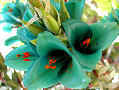
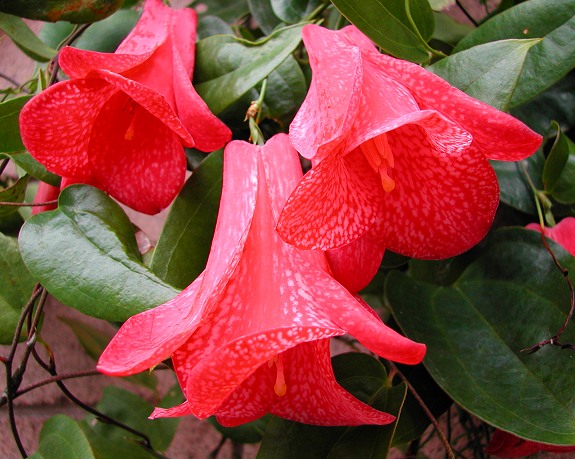
Chilean Bellflower
Germinating the seeds
Stored seeds don't germinate well, so please deal with them when they arrive. Getting started -- Your seeds should be given a 6 week cold treatment in the refrigerator for best germination. This tricks them into thinking winter has passed, so they germinate better. Place the seeds in a small, sealed, plastic or glass container, and fill it with a few ounces (100-200mL) water. Place them in a refrigerator that doesn't freeze (inside the door is usually the warmest part). Mark your calendar to change the water once a week, and remove them after 6 weeks. After cold-treatment -- Use pots about 3-4 inches tall (8-10 cm) and 3 inches wide, with drainage holes. Alternative, you may plant them all in a single pot, by spacing them 2 inches (5cm) apart. Use a well-draining soil mix, such as 2 parts potting soil to 1 part perlite or coarse horticultural sand. An alternate mix is equal parts of coir fiber and perlite (use small- or medium-size perlite, not big chunks). You may add some granular fertilizer, but don't add lime to the mix, because they prefer slightly acid soil. Place a seed in each pot, and cover with a thin layer of soil (1/8 inch / 3 mm) of the mix. Add enough water so the soil is evenly moist, but not completely saturated. If your tap water is very high in minerals ("hard water") it's best to use bottled water or rain water. Until the seeds sprout, keep the pots between 60-78 degrees F (15-25°C) during the day, and a bit cooler at night (50 to 74°F / 10-23°C). Avoid letting them get above 82 degrees F (28°C). I recommend placing a minimum/maximum thermometer near the pots, especially if using a heat mat. Give them some air circulation to prevent stem rot later. Don't let the soil surface dry out, but don't keep the soil constantly soggy either. The seeds sprout at different times, usually beginning between 6 and 12 weeks, and continuing for another 2-4 months. Once they sprout, give them bright light, but shade them from strong sun exposure (See: "Growing indoors with LED lights"). Water them enough to keep the soil surface from drying out (but again, avoid keeping them soggy). Avoid transplanting them the first year. Growing onward.. Lighting -- Lapageria likes a few hours of direct sun, but it should be shaded from strong, hot sun. Your plant was grown in filtered light and should be acclimated to sun slowly over 2-4 months, watching for possible burning. Climate -- It prefers mild daytime temperatures and cool nights. It's happiest between about 40 and 85 degrees (5-29°C), and above freezing. Adult plants are reported to tolerate down to the low 20s (-5°C) if given overhead protection. But protect your seedlings from frost the first 3-4 years. In warmer climates, keep the pot shaded so the roots stay cool. An easy way to do this is to place the pot inside a second pot made of clay, and fill any extra space with soil. Over about 40% humidity is best. If it seems to suffer in low humidity indoors, consider using an ultrasonic room humidifier, sold at home improvement stores and some thrift shops.
Fertilizing
-- Seedlings grow slowly the first 2 years and don't need much fertilizer during
this time. The first 6 months, feed every 2 months with some diluted (1/8 strength) liquid fertilizer.
Hydroponic fertilizer
is ideal for seedlings, because it is easily absorbed and contains all essential
nutrients. After
6 months, you may switch to a granular fertilizer Transplanting -- Repot carefully to avoid disturbing the root mass. If the plant doesn't slide out, you might need to carefully cut the pot away. When your seedlings are 12-18 months old, they may be transplanted to 1-2 quart (1-2 liter) pots, which can hold them for 1-2 years. Then can go into a 1-2 gallon (4-8 liter) container, which can hold them until they flower. After another 2 years, you can move them to a 3-5 gallon (11-19 liter) containers. Support -- Adult plants prefer to twist around a trellis, fence, wires, etc. Small seedlings shouldn't need support. Flowering- When your plant nears flowering size, expose it to cool night temperatures in the fall and spring to encourage blooming. Aim for at least 8 hours a day below 59 degrees F (15°C) for 6 weeks, but keep it above 35 degrees F (2°C). Pests to watch for -- Protect from snails and slugs, which love the leaves. Watch for any pests that affect your other plants. If you have any questions, please email me. Have fun growing them! - Jeff Strange Wonderful Things
|
|||||||||
 that contains micronutrients,
feeding every 4 months. When growth speeds up after about 2 years,
increase the feeding to every 2-3 months, except when temperatures are cold.
that contains micronutrients,
feeding every 4 months. When growth speeds up after about 2 years,
increase the feeding to every 2-3 months, except when temperatures are cold.